Where law, language and democratic life intersect
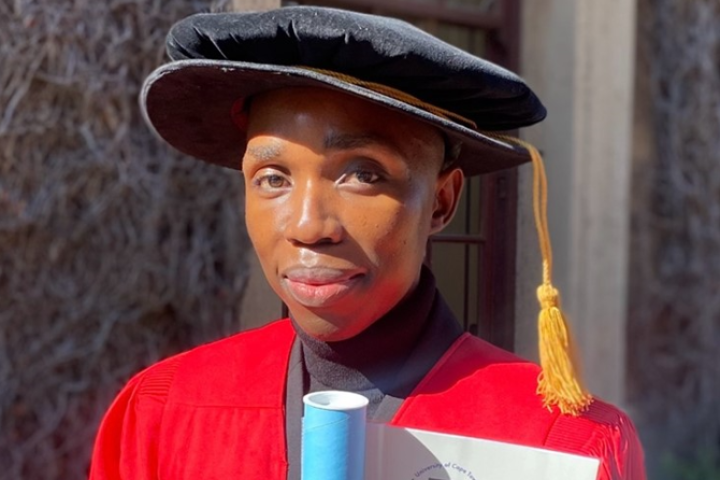
Postdoctoral fellow Dr Thapelo Teele works in a space where law, language and democratic life intersect. Based in Rhetoric Studies within the Department of Private Law, and supervised by Professor Jaco Barnard-Naudé, his project examines how rhetoric operates both inside and outside formal judicial settings—particularly in societies recovering from conflict.
Thapelo’s postdoctoral research, titled ‘Law as Rhetoric, Rhetoric as Law’, explores how democratic deliberation contributes to peacebuilding in fragile and post-conflict contexts. Drawing on case studies from South Africa and Rwanda, Thapelo investigates what he calls the ‘judicial space’ - not only the courtroom itself, but also the wider social and political environments in which citizens engage with one another. At the heart of his work is a set of interconnected themes: the role of rhetoric in democratic participation; language as a defining human capacity; equality rooted in linguistic agency and the lingering cycle of violence that can persist even after formal conflict has ended.
Thapelo’s interest in these questions began during his PhD at UCT Law, where he examined the law’s authority to inscribe implicitly the rhetoric of forgiveness through statutory bodies tasked with truth recovery, justice, peace, and reconciliation. His doctoral research set the foundations for his current project, and he describes the postdoctoral fellowship as an opportunity to expand ideas that could not be fully developed within the limits of a dissertation. This current postdoc work is deliberately interdisciplinary, drawing from law, philosophy, political theory, and conflict studies.
Thapelo aims to produce a cohesive body of research that shows how rhetoric functions as a tool for democratic engagement—whether in schools, workplaces, sports fields, or streets. He is particularly interested in how everyday interactions between citizens help to build, maintain or destabilise peace. One of his goals is to outline a roadmap for understanding how citizens use deliberation, spoken and unspoken, to govern themselves. This includes examining how political relationships are formed, how identity influences conflict, and how societies might interrupt the lifecycle of violence that can re-emerge in democracies transitioning from conflict.
For Thapelo, the excitement lies not only in the subject matter but also in the intellectual ecosystem around him. He notes the support of his PI, mentors, the ATAP programme, the Emerging Researcher Programme, and the wider digital and academic communities at UCT. Thapelo notes that engagements with scholars and practitioners working in transitional justice, conflict studies and democracy theory, ensures further depth to the work.